
English 
No. 39 Tangning Road, Yunhe Street, Linping District, Hangzhou City, Zhejiang Province
Views: 0 Author: Site Editor Publish Time: 2026-03-10 Origin: Site


If you’re producing tent water tanks, flexible water bladders, or PVC/TPU tarpaulin products at scale, “continuous welding” is not a marketing phrase—it’s a production requirement. Every buyer who asks “Can a High Frequency Continuous Tent Water Tank Welder work continuously?” is really asking a deeper question: Will the machine maintain stable weld strength, speed, and quality through long shifts without overheating, drifting, or causing rework?
From our manufacturing perspective, a high frequency continuous welder can absolutely be designed for long, stable runs—but “continuous” depends on the full system: generator stability, cooling design, electrode condition, line speed, material thickness, ambient temperature, and operator routine. In other words, a machine can be capable of continuous operation on paper, but real production continuity is achieved through proper setup + correct parameters + preventive checks. When those are in place, continuous HF welding becomes predictable and repeatable—exactly what you want for tent water tank seams where leak risk is not negotiable.
In this article, we’ll explain what continuous operation means for a High Frequency Continuous Tent Water Tank Welder, what factors limit runtime, how to build a stable long-shift process, and what buyers should confirm before purchasing or upgrading a welding line.
In real production language, “work continuously” means:
The machine can run for long shifts (often hours at a time)
Output power stays stable (no sudden drops that weaken seams)
Weld temperature and pressure remain consistent
The system does not trip frequently on overheating or protection alarms
Weld quality remains consistent from the first meter to the last meter
This is different from “the generator can turn on continuously.” HF welding is a process system, and the process must stay stable.
High frequency welding systems have a designed operating duty. A production-grade continuous welder is built to handle high duty operation without drifting in output.
In practice, stability depends on:
generator power rating matched to your material thickness and speed
RF output stability under load
correct tuning and matching for your electrode setup
Continuous operation is mostly limited by heat—heat in:
the generator components
the electrode/tooling area
the drive system and pressure rollers
the control cabinet environment
A line that runs 20 minutes fine but drifts after 2 hours usually has a thermal stability issue. Industrial continuous systems typically rely on:
robust air or water cooling design (depending on model)
clean airflow paths and maintained filters
stable ambient conditions around the equipment
In continuous HF welding, electrodes/rollers and tooling are “consumables.” As they wear, the effective contact and energy distribution change, which affects seam appearance and strength.
Common continuity problems caused by tooling include:
uneven pressure due to misalignment
surface contamination causing unstable heating
worn edges creating overheat spots or weak bonding lines
Even a perfect machine cannot weld continuously with consistent results if the input material varies.
Factors that affect stability:
thickness variation across rolls
inconsistent surface treatment or coatings
moisture, dust, or release agent contamination
feeding tension and tracking accuracy
When pushing for maximum throughput, some lines run too close to the edge of their welding margin. That creates a “works now, fails later” scenario when temperature rises, material changes slightly, or the operator adjusts pressure.
A stable continuous process usually includes a buffer:
not always running at absolute peak speed
using parameter windows that tolerate normal variation
If your High Frequency Continuous Tent Water Tank Welder is struggling to run continuously, you often see one or more of these signs:
Seam strength decreases after long runtime
Weld appearance changes mid-shift (color, gloss, deformation)
You need to keep adjusting power to maintain bonding
The generator trips on thermal protection
Rollers become too hot and start marking the material
Scrap rate increases after 1–2 hours of continuous production
These signs indicate the machine is running, but the process is not stable.
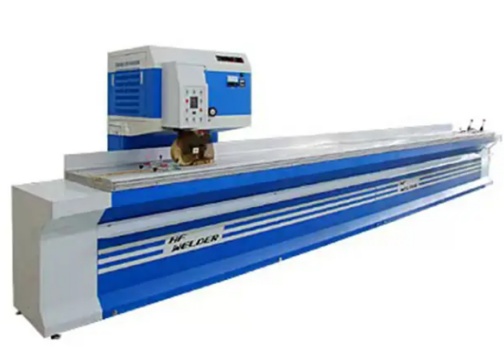
From our production viewpoint, continuous operation is achieved through a “system routine,” not a single setting.
You need enough power and mechanical stability for:
your maximum material thickness
your target seam width
your target line speed
your daily output expectations
If you’re welding thick PVC/TPU seams for tent water tanks, undersized systems will often run “okay” at the start, then drift or overheat later.
For stable production, define:
power range
pressure range
speed range
cooling target range
This gives operators a controlled way to keep the process stable without random “trial and error.”
Continuous lines stay continuous when small issues are caught early.
Examples of simple checks:
electrode/roller temperature feel check (or sensor reading)
seam visual inspection every defined length
quick peel/tear check samples at intervals
cooling airflow and filter cleanliness checks
Stable welding depends on stable feeding:
keep tension consistent
keep alignment stable
prevent wrinkles before welding
store materials properly to reduce contamination
If you want continuous operation, the machine must be kept in “continuous condition”:
clean cooling filters
inspect electrodes/rollers for wear
confirm alignment regularly
keep electrical connections tight and clean
record parameter drift and address root cause
Factor | What can go wrong in continuous work | What to do in production |
Generator sizing | Power drift, weak seams at speed | Choose capacity with margin |
Cooling | Overheat trips, weld inconsistency | Maintain airflow/water cooling, clean filters |
Tooling wear | Uneven seams, overheating spots | Schedule roller/electrode inspection |
Material variation | Random leak failures | Standardize material supply and storage |
Feeding tension | Wrinkles, tracking drift | Use stable guides and tension control |
Operating window | Constant adjustments | Define a controlled parameter range |
If you’re buying a High Frequency Continuous Tent Water Tank Welder specifically to run long shifts, we recommend confirming:
Rated continuous duty expectations
Ask how the system is designed to handle long shifts and what cooling method is used.
Cooling configuration and site requirements
Confirm airflow space, ambient temperature limits, and maintenance schedule.
Power margin for your thickest material
Provide your max thickness and seam width; select a system that can handle it without running at the edge.
Tooling life and replacement plan
Understand electrode/roller maintenance frequency in continuous operation.
Control stability and repeatability
Look for stable control logic and easy parameter repeat.
Process support
For continuous production, commissioning and parameter setup support matters as much as hardware.
Yes—a High Frequency Continuous Tent Water Tank Welder can work continuously, but continuous production success depends on the total system being designed and operated for long shifts: adequate generator capacity, robust cooling, stable tooling, controlled feeding, and a repeatable parameter window. When these conditions are met, it’s realistic to run long production cycles with stable seam quality—exactly what tent water tank manufacturing requires.
If your goal is consistent, leak-resistant seams for tent water tanks, continuous HF welding is one of the most efficient production methods—when the machine and process are built for it. The key is to treat “continuous” as a combination of duty rating + thermal stability + tooling condition + process control, not simply “the machine runs without stopping.” When you plan for these factors, you gain smoother production, fewer adjustments, and a lower rework rate across long shifts.
At Hangzhou Kotin Tarpaulins Co., Ltd., we work with customers who manufacture tarpaulin structures, flexible tanks, and water storage products, and we understand the real production needs behind continuous welding. If you’d like to learn more about solutions and practical guidance related to High Frequency Continuous Tent Water Tank Welder production, you can learn more through Hangzhou Kotin Tarpaulins Co., Ltd. and contact our team for details and support.
It can, if the generator capacity, cooling system, and tooling are designed for high-duty operation and the process window is controlled.
Thermal stability is the main limit—cooling, tooling temperature, and generator heat management determine whether output stays consistent.
Common causes include overheating, tooling wear, material variation, and operating too close to maximum speed without a process margin.
Confirm duty expectations, cooling configuration, power margin for your thickest material, tooling life plan, and process support for commissioning.

