
English 
No. 39 Tangning Road, Yunhe Street, Linping District, Hangzhou City, Zhejiang Province
Views: 0 Author: Site Editor Publish Time: 2026-03-03 Origin: Site


Water storage and transport are central challenges in modern agriculture, especially in regions where irrigation infrastructure must remain flexible, mobile, and cost-efficient. At Hangzhou Kotin Tarpaulins Co., Ltd., we frequently work with growers, contractors, and project engineers who need temporary or semi-permanent water storage solutions that can adapt to changing field conditions. One of the most widely used solutions is the PVC Irrigation Water Bladder — a flexible storage system designed to hold and distribute water safely under controlled pressure.
A common question we receive is straightforward but important: What pressure can a PVC irrigation water bladder bear? The answer depends on multiple factors including material thickness, welding quality, structural design, installation conditions, and how the bladder is used within the irrigation system. Understanding pressure capacity is essential not only for safety, but also for long-term durability and efficient irrigation performance.
Unlike rigid tanks, a PVC irrigation water bladder is not designed to function as a high-pressure vessel. Instead, it is a low-pressure storage system that distributes water primarily through gravity or controlled pumping.
Pressure inside a bladder comes from:
Water height (hydrostatic pressure)
Pump input pressure
External compression
Flow resistance in irrigation lines
In most agricultural applications, the bladder stores water at relatively low pressure while downstream pumps or drip systems regulate irrigation pressure separately.
Pressure capacity varies by specification, but most PVC irrigation water bladders operate within a predictable range.
Bladder Type | Typical Working Pressure | Notes |
Standard irrigation bladder | 0.02–0.05 MPa | Gravity storage use |
Reinforced agricultural bladder | 0.05–0.1 MPa | Pump-assisted systems |
Heavy-duty engineered bladder | Up to ~0.15 MPa | Specialized applications |
These values reflect working pressure, not burst pressure. Safety margins are always included in design.
In practice, irrigation bladders are optimized for stability rather than pressure resistance.
Pressure capacity in a PVC irrigation water bladder is not controlled by one single feature. It is the combined result of material strength, seam integrity, geometry, and field installation. Many users assume “thicker PVC” automatically means “higher pressure,” but in reality, seams and installation conditions often become the true limiting factors. A well-designed bladder is engineered for a stable working pressure range—not for high-pressure duty like rigid tanks or pipelines—so understanding the factors behind pressure helps you size, install, and operate it safely.
The base fabric defines the structural limits. A bladder’s pressure tolerance starts with the reinforced PVC fabric, because the reinforcement carries most of the tensile load as the bladder expands.
Key variables include:
Polyester reinforcement density: Higher density generally increases tensile strength and improves shape stability under load.
PVC coating thickness: Thicker coating improves abrasion resistance, water tightness, and surface protection, but must be balanced with flexibility.
Tear resistance: Field use includes dragging, ground contact, and occasional impact—tear resistance matters as much as tensile strength.
Flexibility balance: A bladder must remain foldable and deployable. If the fabric becomes too stiff, it may crease more aggressively and create stress points at folds.
In practice, heavier fabric usually supports higher pressure, but the design must still allow bending, folding, and repeated handling without cracking or weakening.
Seam strength is often the real pressure limit. Even if the fabric is strong, a weak seam can fail first because seams concentrate stress at transitions and corners. High-frequency welding and controlled seam design help ensure uniform stress distribution across bonded areas.
What welding quality affects:
Consistency along the seam: Weak spots can become the starting point of a leak or seam split.
Bond width and overlap: Wider, correctly overlapped seams generally handle load more evenly.
Stress distribution at junctions: Multi-panel intersections are common stress zones and require careful design.
Poor welding can reduce pressure tolerance significantly—even when the fabric itself is high grade—so seam control is a core safety factor, not a cosmetic detail.
Large bladders experience different stress patterns than small ones. Pressure does not act uniformly in real structures: it concentrates based on geometry, water height, and where the bladder is constrained.
Key shape impacts include:
Wide, low-profile bladders distribute pressure better, reducing peak seam loading.
Tall water columns increase hydrostatic pressure, especially near the bottom and lower seams.
Geometry affects seam loading: Sharp corners, narrow ends, or abrupt transitions increase stress concentration.
Design optimization improves safe pressure performance: Panel layout, seam positioning, and reinforcement placement are all used to reduce high-stress zones.
This is why two bladders made from the same fabric can have different pressure behavior if their shape and seam layout are different.
Pressure tolerance depends heavily on how the bladder is installed. Field installation can either protect the bladder or create hidden stress points that reduce its effective working capacity.
Important considerations:
Flat ground support: Uneven ground creates localized bending and abnormal seam stress.
Protection from sharp objects: Stones, roots, metal edges, and gravel can damage the base or create abrasion points.
Even filling: If the bladder fills unevenly, certain seams may take load early and stretch more than intended.
Avoiding localized compression: Heavy objects, vehicle tires, or hard edges pressing into the bladder can create concentrated stress that mimics high internal pressure.
Improper installation is a common cause of premature failure, even when the bladder is otherwise correctly selected.
It is important to distinguish these terms:
Parameter | Meaning |
Working pressure | Safe continuous operating range |
Test pressure | Short-term validation level |
Burst pressure | Failure threshold |
PVC irrigation water bladders are engineered with safety factors, meaning burst pressure is significantly higher than the recommended working pressure. However, the user should always operate within working pressure, because repeated exposure to high stress can accelerate seam fatigue and reduce service life even if “burst” never occurs.
The bladder rarely operates alone. Pressure behavior depends on the full irrigation setup, including how water is delivered and how line pressure is controlled.
Pressure is determined by water height and is typically low and stable. These systems are usually the easiest for bladder storage because the pressure increase is predictable and slow.
Pumps must be controlled to avoid over-pressurizing the bladder. Rapid ramp-up, valve closure, or uncontrolled pump output can create sudden pressure spikes that exceed the safe working range.
In many drip systems, the bladder functions mainly as storage while regulators control line pressure. In this setup, pressure stability depends more on regulators, valves, and layout than on the bladder itself.
System design often matters more than material strength. A well-controlled system can protect a bladder even in demanding conditions, while a poorly controlled pump system can damage a bladder quickly.
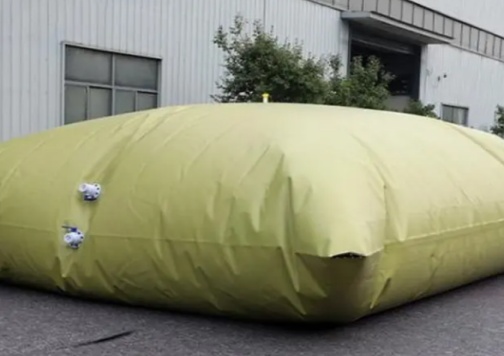
PVC irrigation water bladders are intentionally designed for low pressure because this provides practical benefits:
Reduced structural stress
Lower material weight
Easy transport and deployment
Safer operation
Longer lifecycle in field conditions
This design philosophy supports agricultural flexibility.
Based on field experience, we recommend:
Selecting the correct fabric specification
Confirming maximum water height during installation
Using pressure control valves in pump systems
Filling gradually during first use
Monitoring seam areas during operation
Preventive measures significantly improve reliability.
Operators should watch for early warning indicators:
Unusual stretching
Bulging at seams
Uneven shape formation
Increased seam stress marks
Difficulty closing fittings
These signs suggest pressure may be too high.
Modern PVC tarpaulin technology improves pressure tolerance through:
Multi-layer coatings
Anti-aging formulations
Reinforced yarn structures
Flexible welding compatibility
Material innovation allows higher reliability without sacrificing flexibility.
Pressure requirements differ across applications.
Application | Pressure Importance |
Field storage | Low |
Temporary irrigation buffer | Low–moderate |
Remote water transport | Moderate |
Emergency water supply | Moderate |
Most irrigation scenarios prioritize durability over high pressure.
Understanding what pressure a PVC Irrigation Water Bladder can bear is less about finding a single number and more about understanding design intent. These systems are engineered as flexible, low-pressure water storage solutions that prioritize safety, adaptability, and operational reliability rather than high internal pressure resistance.
In real agricultural environments, pressure capacity depends on material strength, seam quality, bladder geometry, and installation conditions. When properly selected and installed, PVC irrigation water bladders provide stable performance, efficient water storage, and long service life across a wide range of irrigation scenarios.
At Hangzhou Kotin Tarpaulins Co., Ltd., our approach focuses on matching bladder specifications to real application needs. By combining material engineering, controlled manufacturing processes, and practical field experience, we support customers in choosing water storage solutions that operate safely within appropriate pressure ranges. If you are evaluating irrigation storage options or need guidance on pressure requirements for your project, learning more about PVC irrigation water bladder solutions and discussing your application with our team can be a helpful next step.
1. What is the typical working pressure of a PVC Irrigation Water Bladder?
Most operate between 0.02 and 0.1 MPa depending on material and design.
2. Can a PVC Irrigation Water Bladder handle pump pressure directly?
It can handle controlled low pump pressure, but regulators are recommended.
3. What determines the pressure limit of a PVC Irrigation Water Bladder?
Material strength, seam quality, bladder geometry, and installation conditions.
4. Are PVC Irrigation Water Bladders designed for high-pressure storage?
No, they are low-pressure flexible storage solutions intended for irrigation systems.

