
English 
No. 39 Tangning Road, Yunhe Street, Linping District, Hangzhou City, Zhejiang Province
Views: 0 Author: Site Editor Publish Time: 2026-03-05 Origin: Site


When customers ask us, “What’s the storage capacity of a Portable Water Storage Bladder?” they’re often trying to solve a real operational problem: how to store and move water quickly when tanks are too rigid, too heavy, or too slow to deploy. A portable water storage bladder is designed exactly for that—flexible capacity, fast setup, and compact storage when empty. But “capacity” is not just one number printed on a label. The practical capacity depends on bladder dimensions, shape, material strength, fill height, site conditions, and the way you plan to use the bladder (temporary storage, transport, emergency reserve, or field supply).
At Hangzhou Kotin Tarpaulins Co., Ltd., we work with customers who use portable water storage bladders in agriculture, construction sites, disaster response, remote camps, and industrial water management. In this guide, we’ll explain common capacity ranges, how storage capacity is calculated, what factors affect real usable volume, and how to choose the right bladder size for your project.
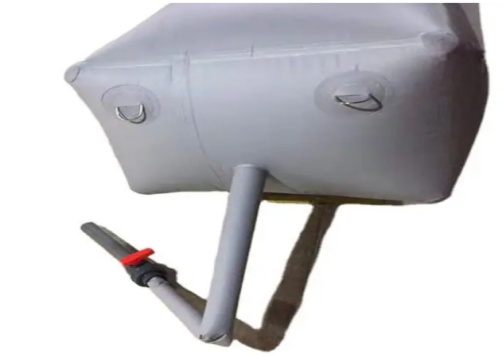
A portable water storage bladder is a flexible, collapsible container made from coated technical fabric (often PVC-based or similar engineered tarpaulin materials), designed to store water temporarily or semi-temporarily. When empty, it folds into a compact bundle. When filled, it forms a stable reservoir—often used where rigid tanks are not practical.
Typical design features include:
welded or heat-sealed seams
inlet and outlet ports (flanged or threaded)
reinforcement in stress areas
optional protective ground sheets
handles or lifting points on some designs
Portable water storage bladders are available in a wide range of volumes. In many markets, standard product categories often include:
Small portable bladders: 100–1,000 liters
Medium field bladders: 1,000–10,000 liters (1–10 m³)
Large storage bladders: 10,000–50,000 liters (10–50 m³)
Extra-large engineered solutions: 50,000 liters and above (custom projects)
The “right” range depends on whether you’re supplying a small work team, supporting irrigation buffer storage, or building an emergency water reserve for remote operations.
Manufacturers often list a nominal capacity (theoretical volume based on full design fill). In real use, many customers choose to operate slightly below maximum to reduce stress, improve stability, and allow for site variation.
Portable bladders may be:
pillow-style
rectangular low-profile
elongated transport-focused designs
A lower-profile shape may spread wider and appear “bigger” on the ground, but it may have different fill behavior compared with a taller design. Fill height affects internal pressure at the seams and ports, which is why capacity selection should consider both volume and footprint.
Use case | Typical capacity range | Why this range is common | Notes |
Small site water buffer | 500–2,000 L | easy handling and fast fill | good for short-term storage |
Construction / remote work camps | 2,000–10,000 L | supports daily operations | consider pump connection needs |
Agriculture / irrigation support | 5,000–30,000 L | buffer for supply variability | footprint planning matters |
Emergency response / relief | 10,000–50,000 L | scalable field deployment | prioritize fast setup & durability |
Industrial temporary storage | 10,000 L+ | project-based water control | often custom port layouts |
Even if two Portable Water Storage Bladder models share the same nominal volume on paper, real-world capacity and performance can differ significantly once the bladder is deployed outdoors. In our experience, “capacity” is not only a number—it’s the result of site conditions, connection design, and how conservatively the bladder is operated over time. Below are the most common factors that change usable volume in the field and determine whether the bladder performs smoothly or becomes difficult to manage.
A flat, smooth surface supports full-capacity use much more safely. When the ground is uneven, the bladder does not expand evenly, and that creates concentrated stress in specific zones. Typical problems include:
stress points on seams where the bladder folds or bends over rocks and ridges
uneven fill distribution, which can reduce usable volume and make the bladder “bulge” irregularly
risk of abrasion on the base, especially if sand, gravel, or sharp stones are present
Practical tip: Always use a groundsheet, clear sharp stones, and avoid setting the bladder where the ground slopes or has hidden debris. A small amount of preparation often protects a large investment.
Extreme environments affect both material behavior and operating stability. When selecting capacity, think about where the bladder will sit and for how long:
outdoor sun exposure can heat the surface and raise the internal temperature of the stored water
temperature variation (day vs night) can change the “feel” of the bladder and how seams and fittings are loaded
storage duration and inspection schedule matter—longer deployment typically benefits from a more conservative fill level and routine checks
In hot climates, it’s common to operate with extra margin rather than filling to the maximum, because stable long-term performance is more important than the last few percent of volume.
A large bladder capacity only helps if you can fill and discharge it efficiently. Many field delays happen because the bladder is “big,” but the connection plan is too small or not compatible with existing equipment. Confirm:
port size (inlet/outlet diameter) to match the pump flow you need
compatibility with your pumps and hoses (thread type, flange size, couplings)
venting behavior during fill/empty, which affects speed and stability
whether you need multiple outlets for distribution (for example, supplying more than one line or using a main outlet plus a drain outlet)
A good rule is to plan the whole water system as one workflow: pump → hose → bladder ports → distribution. If one link is undersized, the whole operation slows down.
If you plan to move a bladder while filled, it becomes a specialized selection. Most portable water storage bladders are designed primarily for stationary deployment once filled. Moving a filled bladder introduces dynamic stress, sloshing behavior, and handling risks that standard site storage designs may not be optimized for.
Practical takeaway: If transport is part of the plan, specify it clearly at the selection stage. The design, reinforcement, and connection layout may need to be different compared with a stationary storage model.
For longer storage time, many users choose a conservative fill level rather than pushing to the maximum. This approach:
reduces seam stress
improves stability on imperfect ground
provides buffer for environmental changes (especially heat)
lowers risk during unexpected site events (minor shifts, vibration from machinery nearby, etc.)
In long-term deployments, reliability and low risk usually outweigh the benefit of maximizing every liter.
A reliable selection process starts with your daily water requirement and your operational buffer needs.
Examples:
remote camp: water for cleaning, equipment, and site operations
agriculture: irrigation schedule and supply variability
emergency reserve: planned coverage duration
Ask: how many hours or days of reserve do you need?
0.5–1 day buffer
1–3 day buffer
longer contingency storage
Large capacity bladders require more ground space. Before choosing volume, confirm:
usable flat area
access route for delivery and deployment
safe distance from traffic or heavy machinery
drainage plan if the area floods
Your hoses, pumps, and connectors should match the bladder ports. Capacity without compatible connections slows deployment and causes site improvisation.
Capacity selection is linked to material strategy. Higher capacity typically means higher stress loads and a greater need for:
stronger fabric base
reliable welding
reinforced port zones
abrasion resistance
So, what’s the storage capacity of a Portable Water Storage Bladder? The answer depends on the model and purpose—portable bladders commonly range from a few hundred liters to tens of thousands of liters, with custom solutions available for larger needs. The most reliable way to choose the right capacity is to evaluate your daily demand, required reserve time, available ground space, and fill/empty requirements, then select a working capacity with a sensible safety margin.
To learn more about portable water storage bladder sizes, configurations, and material options, you’re welcome to contact Hangzhou Kotin Tarpaulins Co., Ltd. for more information.
Many projects use 1,000–10,000 liters for general field storage, while emergency and agriculture often scale to 10,000 liters and above.
Estimate daily water demand, decide how many days of buffer you want, then confirm footprint space and pump connection requirements.
Not always. Many users operate below maximum fill for stability and safety margin, especially on uneven ground or in hot environments.
Confirm ground conditions, inlet/outlet port sizes, hose/pump compatibility, material grade, seam construction, and how long the bladder will stay deployed.

